This morning hopefully finds our whole group well rested after a long day of travel. The sun has not yet had a chance to burn away the clouds but it looks like it will be a beautiful day. Pleasantly, it began several hours ago with being awakened to a serenade of sorts. My own cloudy sleep-brain did not record what the women down on the street were singing, or even whether they were singing in Spanish or Quechua, but somehow I was sure that they were singing some sort of off-to-work hymn... Or maybe a dirge. I say "pleasantly" because it was early enough that I was able to get back to sleep- and waking in this clean mountain air is always great. Interestingly, Huaras may be a very musical town- because we discovered last night that the garbage truck makes it's rounds with a pre-recorded happy song that sounded almost like a Disney ride soundtrack. It was the only time I ever stopped to watch a garbage truck inch it's way along the street. Sean Byrne even took video! We will be sure to post when we return home.
In a few hours we will make the trek to REAL altitude... from about 8000 ft to 12,000 ft. We have a terrific group of volunteers and are more organized than ever. I think that building the greenhouse is going to be a terrific way to get a real sense of accomplishment. The medical and dental campaigns are always amazing but the work is never done and we leave wishing we could have done more. The greenhouse SHOULD bring a sense of completion. We'll keep fingers crossed that we are able to finish the work in the 3 short work days that we have.
We'll keep writing along the way though there may or may not be new posts before Wednesday when we get back to Huaras. Depending on Internet service in Pampas.
Hope all is well back in the states! Thanks again for following and supporting our work.
Sean
Sean McKenna, MD
Saturday, March 3, 2012

Friday, March 2, 2012
Arrived in Peru!!!

(David excited about the bus ride while everyone sleeps)
After a long plane ride with a short stop in Bogota to switch planes, we arrived at Jorge Chavez Airport in Lima, Peru where we were greeted by our favorite dentists - Sandra and Erika - and our favorite doctor - Paula.
We met Clemente - our driver this year and highly recommended by Gustavo (our driver of our previous trips) and started the long process of loading our bags to the roof of the bus.
We are traveling tightly this year with all seats taken. There are 18 of us from the USA, our 2 dentists - Sandra and Erika, a translator - Adela (younger sister to Carla - our translator last year), and a five member band - Motif. The band will be doing a music workshop with the kids in pampas and its exciting to share music tastes with them. (Antonio - the lead singer - and I bonded over our love for Dispatch and I shared some live albums I have!).

(The sleeping students.)
After a long trip from 3 am to 11:30 am, we made it Huaraz! Checking in, lunch at a familiar restauarant, some opted to sleep, but most went for exploring. We checked in at Cafe Andino and enjoyed coffees and local Huaraz microbrews and followed our beverage break with a visit to the Regional Archaeology Museum of Ancash which has an impressive collection of ancient stone sculptures.
Right now, we are resting in the hotel and getting ready to head to dinner. We can feel the altitude here at 8000 feet so some acclimatization is already needed. We'll meet over dinner to finish prep on our projects and then break for the night. Tomorrow we face a 5 hour climb to Pampas Grande. The true distance is very short but the roads make the trip long.
We will post some pictures tonight!
Sid Dante
M4, VCU School of Medicine
Vice-Chair, Richmond Global Health Alliance
Wednesday, January 4, 2012
High Altitude and Healthy Skin: A Public Health Concern
Last spring, education officials in Cusco and Arequipa, Peru issued a mandate for all school children to wear hats during the day in order to protect children’s skin from sun damage. The education officials made this decision in response to a recent study released by the Peruvian Dermatological Society, which showed that over 70% of randomly selected young adults in the region had abnormal skin pathology. Elevations in these mountainous regions reach around 12,000 feet above sea level, and UV levels often exceed those that are considered dangerous to the skin.
In Pampas Grande, where the altitude is around 13,000 feet above sea level, many children who visit the clinic complain about lesions on their skin, most commonly blotchiness on their face and cheeks. In a group discussion, the Richmond Global Health Alliance came up with the hypothesis that sun exposure is causing this skin damage. Under the leadership of first-year MCV medical student Morgan Vargo and pediatrician Sean McKenna, RGHA organized an observational study looking at the effect of sunscreen on the symptoms of damaged skin. For the study, a group of volunteer middle school-aged girls agreed to apply sunscreen to their faces every day before school and to be photographed periodically at the clinic. Changes in skin symptoms will be compared to girls who did not apply sunscreen every morning.

In the future, RGHA hopes to continue increasing awareness in high-altitude Peruvian communities about the possible negative effects of sun exposure to the skin. Although few data exist on the effects of sun exposure at high altitudes and skin cancer, RGHA will work go gather information about this serious health outcome in these regions.
In Pampas Grande, where the altitude is around 13,000 feet above sea level, many children who visit the clinic complain about lesions on their skin, most commonly blotchiness on their face and cheeks. In a group discussion, the Richmond Global Health Alliance came up with the hypothesis that sun exposure is causing this skin damage. Under the leadership of first-year MCV medical student Morgan Vargo and pediatrician Sean McKenna, RGHA organized an observational study looking at the effect of sunscreen on the symptoms of damaged skin. For the study, a group of volunteer middle school-aged girls agreed to apply sunscreen to their faces every day before school and to be photographed periodically at the clinic. Changes in skin symptoms will be compared to girls who did not apply sunscreen every morning.

Sean Byrne with two brothers in Pampas Grande. Like many children in Pampas Grande and surrounding communities, these boys have slight red irritation on their cheeks. RGHA is actively seeking a solution to help reduce these visible symptoms of skin damage.
Saturday, December 3, 2011
Project Update
Thank you to all who attended our event, Experiences in Peru: Medicine, Education and Life in the Andes. We were so excited to showcase our work and experience the Achachis y Bordados exhibit with our friends and family.
Here are some photos taken at the event:


Here are some photos taken at the event:

Michael, Ari, and Colin greeting guests as they enter the Achachis y Bordados Exhibit in the Lora Robins Gallery at the University of Richmond

Guests looking through the Achachis

Dr. Sean speaking to our guests about who we are and what we do
In other news, we are excited to announce the addition of a new, great group of University of Richmond students to our trip to Pampas Grande in March. These students are UR stand-outs, and we are thrilled to have them working with us on our projects as we plan for Pampas.
Additionally, thanks to Dr. Paula Tamashiro, we now have a comprehensive figure describing our services in Pampas Grande last year. We are using this data to help shape our projects for the trip this spring and for our long-term efforts. Thanks, Dr. Paula!

Monday, October 31, 2011
Experiences in Peru: Medicine, Education and Life in the Andes
Our upcoming fundraising event, Experiences in Peru: Medicine, Education and Life in the Andes, will be held on Saturday, November 12 from 6 to 8pm at the Lora Robins Gallery (next to Boatwright Memorial Library) on the University of Richmond campus. Come and enjoy light refreshments along with a brief lecture from pediatrician Dr. Sean McKenna (top vote-getter for Richmond Magazine's Top Docs of 2011) and a gallery of beautifully embroidered Peruvian tapestries (achachis) and breath-taking photographs of our adventures in Peru. Donations are greatly appreciated, and checks can be made payable to the Richmond Global Health Alliance.


We look forward to seeing you there!
Tuesday, October 25, 2011
Our Projects in Pampas Grande in the Spirit of the Girl Effect
The Nike Foundation’s Girl Effect places its focus on the potential of young women to transform the developing world. The Girl Effect presents strong evidence that investing in a young girl will not only help break the cycle of poverty, but will give her the chance to dictate her own future.
Just watch one of the Girl Effect’s videos, and you will be moved by this organization’s message—that girls are the most powerful force of change in the world.
RGHA too believes in the power of young women to have significant positive impacts on their communities. Three years ago in Pampas Grande, University of Richmond students saw leadership qualities in Leidi, a high school student. The students met Leidi when she performed songs to welcome and thank RGHA for visiting Pampas Grande. Later in the week, during UR student-led discussions in the Pampas Grande high school, Leidi courageously voiced her concerns about her community and how it could be improved. A year later, in a UR student-led interview, Leidi expressed her desire to go to college to study music, and then return to Pampas Grande to be a teacher and a leader in her community.
Led by 2011 University of Richmond graduate MaryGrace Apostoli, RGHA raised enough funds to pay for Leidi's tuition at Jose Maria Arguedas' National Superior School of Folklore in Huaraz, Peru, to which she is expected to apply upon her high school graduation in December. If accepted to the program, Leidi will be the first person in her family to leave Pampas Grande to pursue higher education.
RGHA is looking to continue its investments in girls' potential to create positive outcomes for themselves and their communities. Projects involving microcredit loans and other entrepreneurial aid for women are in the works, so keep an eye out for updates.
Note: Although RGHA believes in the transformative power of young women, it is not officially involved with the Girl Effect or the Nike Foundation.
Just watch one of the Girl Effect’s videos, and you will be moved by this organization’s message—that girls are the most powerful force of change in the world.
RGHA too believes in the power of young women to have significant positive impacts on their communities. Three years ago in Pampas Grande, University of Richmond students saw leadership qualities in Leidi, a high school student. The students met Leidi when she performed songs to welcome and thank RGHA for visiting Pampas Grande. Later in the week, during UR student-led discussions in the Pampas Grande high school, Leidi courageously voiced her concerns about her community and how it could be improved. A year later, in a UR student-led interview, Leidi expressed her desire to go to college to study music, and then return to Pampas Grande to be a teacher and a leader in her community.
Led by 2011 University of Richmond graduate MaryGrace Apostoli, RGHA raised enough funds to pay for Leidi's tuition at Jose Maria Arguedas' National Superior School of Folklore in Huaraz, Peru, to which she is expected to apply upon her high school graduation in December. If accepted to the program, Leidi will be the first person in her family to leave Pampas Grande to pursue higher education.
RGHA is looking to continue its investments in girls' potential to create positive outcomes for themselves and their communities. Projects involving microcredit loans and other entrepreneurial aid for women are in the works, so keep an eye out for updates.
Note: Although RGHA believes in the transformative power of young women, it is not officially involved with the Girl Effect or the Nike Foundation.
Monday, October 3, 2011
Guest Blog: A Visit to Grundy, VA
This past weekend, I was privileged to join University of Richmond students in the Global Health, Medical Humanities, and Human Rights Sophomore Scholars in Residence (SSIR) program for a trip to Grundy, VA to volunteer at a free clinic hosted by Remote Area Medical. Dr. Rick Mayes, the program director and my former professor at U of R, asked me to come along.
I took Dr. Mayes’s Public Health Policy class in Cusco, Peru during the summer of 2009. It was then that I started to make a connection between health disparities in underserved, third-world countries and those in my home state, West Virginia. Dr. Mayes encouraged me to challenge the U.S. health system—which I previously thought to be best in the world—and open my eyes to the idea that people at home suffer from many of the same health disparities as those in third-world countries. It was the summer of 2009 that sparked my passion for public health. So, two and a half years later, when Dr. Mayes asked me to join his group of undergrads in a trip that explored health in the Appalachian region, I jumped at the opportunity.
Here's a picture of Dr. Mayes, a classmate, and me walking to an orphanage in the outskirts of Cusco.
We left on Friday morning for our six-hour journey into the foothills of Appalachia. As soon as we arrived in Grundy, several students adamantly volunteered to stay up the entire night to help set up the clinic and hand out blankets and food to the patients who had camped out. The next morning, the students woke up promptly at 4:00 to start their shift at the clinic. (As a side note, I was late to the jump on Saturday morning. I ended up being the last one out of bed!) They worked until around 3:00 in the afternoon, without the nearest inkling of negativity. I truly can’t say enough about these students—it was so refreshing to be around a group of young people who genuinely care about others and have the courage and will to do something about it. These are the people that are changing the world for the better.
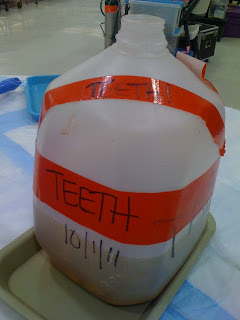
On Saturday, the RAM clinic saw around 680 patients, most of whom sought dental or vision care. I took these photos early Sunday morning of the disposal container of teeth extracted during Saturday’s clinic:

On Saturday and Sunday, RAM officials had to stop the flow of dental patients due to the enormous back-log in dentistry (which contained 34 operating dental chairs and took up the entire cafeteria in the elementary school in which the RAM clinic was held).
I worked the majority of Saturday taking basic information from vision patients as they waited in the two-hour line (do you wear eyeglasses, do you need them for reading, distance, or both, etc.). From my interactions with patients, I noticed that many of them had spent months and even years with no or inadequate vision correction. Among those with whom I spoke who did have vision correction, I only saw one person who wore contact lenses.
For me, vision correction and dental care are major facets of my life. With a -8.0 prescription in both eyes (which has continued to get worse every year since I was 8 years old) and signature Armistead teeth (which took around ten years of orthodontic work to correct), I am a clear image of someone who can lead a healthy life if given proper access to quality healthcare.
Of course, I was lucky that my parents had health, vision, and dental insurance, which was certainly a critical determining factor for receiving access to care as a child. Whether they had insurance or not, though, I know my mom and dad would have done everything they could to see that I would grow up to be healthy. Parents who are uninsured are no different. So many parents traveled hours to Grundy to stand outside in 40-degree weather and cold rain, and then to wait inside for another three hours to ensure that their children were seen by the dentist or optometrist. From my observations, parental intent for pediatric preventative care was strong in Grundy.
However, from my observations, I can’t say that the parents and other adults were focused on preventative care for themselves. If I walked down any hallway containing patients in the clinic, I couldn’t smell anything but nicotine, which had worked its way permanently into the patients’ skin, hair, and clothing. The vast majority of patients in the RAM clinic were smokers, and some had even lit up in the boys’ bathroom (of an elementary school…that was hosting a health clinic). Additionally, in the words of one of the RAM volunteers, the clinic “couldn’t give a pap-smear away if it tried.” Although many patients sought medical care, the line for the general medical practitioner was by far the shortest in the clinic. And last, the image above that illustrates the number of teeth extracted in just one day is a reflection of interventative, rather than preventative, focus on health.
The lack of the adults’ focus on preventative care isn’t entirely of their own fault. These are people who lead hard lives, many of them coal miners or disabled laborers. Even if they have health insurance, many people still don’t receive the benefits of dental or vision insurance. They have little access to fresh produce, and are one of the largest target populations for Big Tobacco. In Pampas Grande, we also see a heavy focus on interventative care rather than preventative care. Like the people in the Appalachian region of the United States, a multitude of factors accounts for this, including limited access to healthcare, labor-intensive lifestyles, and lack of knowledge about the benefits of healthcare. Below is a picture of one of the many patients we saw last spring at the Pampas Grande clinic having a tooth extracted:

My experiences working in these clinics have made me question what the condition of my health would be not only if I lived in a third-world village like Pampas Grande, but if I lived in a different part of my own state. There is clearly a tremendous healthcare injustice occurring both abroad and at home, and we have to do something about it. For the sake of human rights, we must fight against the preventable factors that lead to disease and health disparity. -Blair Armistead
Blair Armistead is a member of RGHA and visited Pampas Grande in the springs of 2010 and 2011. She is a recent UR grad and is currently pursuing her Masters in Public Health at VCU.
I took Dr. Mayes’s Public Health Policy class in Cusco, Peru during the summer of 2009. It was then that I started to make a connection between health disparities in underserved, third-world countries and those in my home state, West Virginia. Dr. Mayes encouraged me to challenge the U.S. health system—which I previously thought to be best in the world—and open my eyes to the idea that people at home suffer from many of the same health disparities as those in third-world countries. It was the summer of 2009 that sparked my passion for public health. So, two and a half years later, when Dr. Mayes asked me to join his group of undergrads in a trip that explored health in the Appalachian region, I jumped at the opportunity.
Here's a picture of Dr. Mayes, a classmate, and me walking to an orphanage in the outskirts of Cusco.

We left on Friday morning for our six-hour journey into the foothills of Appalachia. As soon as we arrived in Grundy, several students adamantly volunteered to stay up the entire night to help set up the clinic and hand out blankets and food to the patients who had camped out. The next morning, the students woke up promptly at 4:00 to start their shift at the clinic. (As a side note, I was late to the jump on Saturday morning. I ended up being the last one out of bed!) They worked until around 3:00 in the afternoon, without the nearest inkling of negativity. I truly can’t say enough about these students—it was so refreshing to be around a group of young people who genuinely care about others and have the courage and will to do something about it. These are the people that are changing the world for the better.
On Saturday, the RAM clinic saw around 680 patients, most of whom sought dental or vision care. I took these photos early Sunday morning of the disposal container of teeth extracted during Saturday’s clinic:


On Saturday and Sunday, RAM officials had to stop the flow of dental patients due to the enormous back-log in dentistry (which contained 34 operating dental chairs and took up the entire cafeteria in the elementary school in which the RAM clinic was held).
I worked the majority of Saturday taking basic information from vision patients as they waited in the two-hour line (do you wear eyeglasses, do you need them for reading, distance, or both, etc.). From my interactions with patients, I noticed that many of them had spent months and even years with no or inadequate vision correction. Among those with whom I spoke who did have vision correction, I only saw one person who wore contact lenses.
For me, vision correction and dental care are major facets of my life. With a -8.0 prescription in both eyes (which has continued to get worse every year since I was 8 years old) and signature Armistead teeth (which took around ten years of orthodontic work to correct), I am a clear image of someone who can lead a healthy life if given proper access to quality healthcare.
Of course, I was lucky that my parents had health, vision, and dental insurance, which was certainly a critical determining factor for receiving access to care as a child. Whether they had insurance or not, though, I know my mom and dad would have done everything they could to see that I would grow up to be healthy. Parents who are uninsured are no different. So many parents traveled hours to Grundy to stand outside in 40-degree weather and cold rain, and then to wait inside for another three hours to ensure that their children were seen by the dentist or optometrist. From my observations, parental intent for pediatric preventative care was strong in Grundy.
However, from my observations, I can’t say that the parents and other adults were focused on preventative care for themselves. If I walked down any hallway containing patients in the clinic, I couldn’t smell anything but nicotine, which had worked its way permanently into the patients’ skin, hair, and clothing. The vast majority of patients in the RAM clinic were smokers, and some had even lit up in the boys’ bathroom (of an elementary school…that was hosting a health clinic). Additionally, in the words of one of the RAM volunteers, the clinic “couldn’t give a pap-smear away if it tried.” Although many patients sought medical care, the line for the general medical practitioner was by far the shortest in the clinic. And last, the image above that illustrates the number of teeth extracted in just one day is a reflection of interventative, rather than preventative, focus on health.
The lack of the adults’ focus on preventative care isn’t entirely of their own fault. These are people who lead hard lives, many of them coal miners or disabled laborers. Even if they have health insurance, many people still don’t receive the benefits of dental or vision insurance. They have little access to fresh produce, and are one of the largest target populations for Big Tobacco. In Pampas Grande, we also see a heavy focus on interventative care rather than preventative care. Like the people in the Appalachian region of the United States, a multitude of factors accounts for this, including limited access to healthcare, labor-intensive lifestyles, and lack of knowledge about the benefits of healthcare. Below is a picture of one of the many patients we saw last spring at the Pampas Grande clinic having a tooth extracted:

My experiences working in these clinics have made me question what the condition of my health would be not only if I lived in a third-world village like Pampas Grande, but if I lived in a different part of my own state. There is clearly a tremendous healthcare injustice occurring both abroad and at home, and we have to do something about it. For the sake of human rights, we must fight against the preventable factors that lead to disease and health disparity. -Blair Armistead
Blair Armistead is a member of RGHA and visited Pampas Grande in the springs of 2010 and 2011. She is a recent UR grad and is currently pursuing her Masters in Public Health at VCU.
Subscribe to:
Posts (Atom)